Last updated: 23 Oct 2026
Seeing blood in your stool, on the toilet paper or in the toilet bowl can be worrying. Often the cause is minor and easily treated, such as piles (haemorrhoids) or a small tear near the back passage. But blood in the stool can also be a sign of a condition that needs investigating, including bowel polyps or colorectal cancer.[1][2] This guide explains what the colour of the blood may suggest, the common causes, the warning signs that need urgent care, and what a doctor may do to find the cause.
What the colour of the blood can tell you
The colour and appearance of the blood can give a clue to where the bleeding is coming from, though it cannot confirm the cause on its own.[1][3]
| What you notice | Where the bleeding may be coming from | Examples of possible causes |
|---|---|---|
| Bright red blood on toilet paper, on the surface of the stool or dripping into the bowl | The anus or the lower part of the bowel (rectum) | Piles, anal fissure |
| Dark red or maroon blood mixed into the stool | Higher up in the large bowel | Diverticular disease, inflammatory bowel disease, polyps, cancer |
| Black, sticky, tar-like stool (melaena) | The stomach or upper digestive tract | Bleeding stomach or duodenal ulcer |
Some foods and medicines can change stool colour without any bleeding. Iron tablets and bismuth-containing medicines can turn stool black, and beetroot can make it look red.[1][3] If you are unsure, it is safer to have it checked.
Common causes of blood in stool
Piles (haemorrhoids)
Piles are swollen blood vessels in and around the back passage. They are one of the most common causes of bright red blood after passing a stool, often with itching or a lump around the anus. Straining and constipation make them more likely.[4]
Anal fissure
An anal fissure is a small tear in the skin of the back passage, usually caused by passing a hard stool. It typically causes a sharp pain during and after a bowel movement, with a small amount of bright red blood.[5]
Diverticular disease
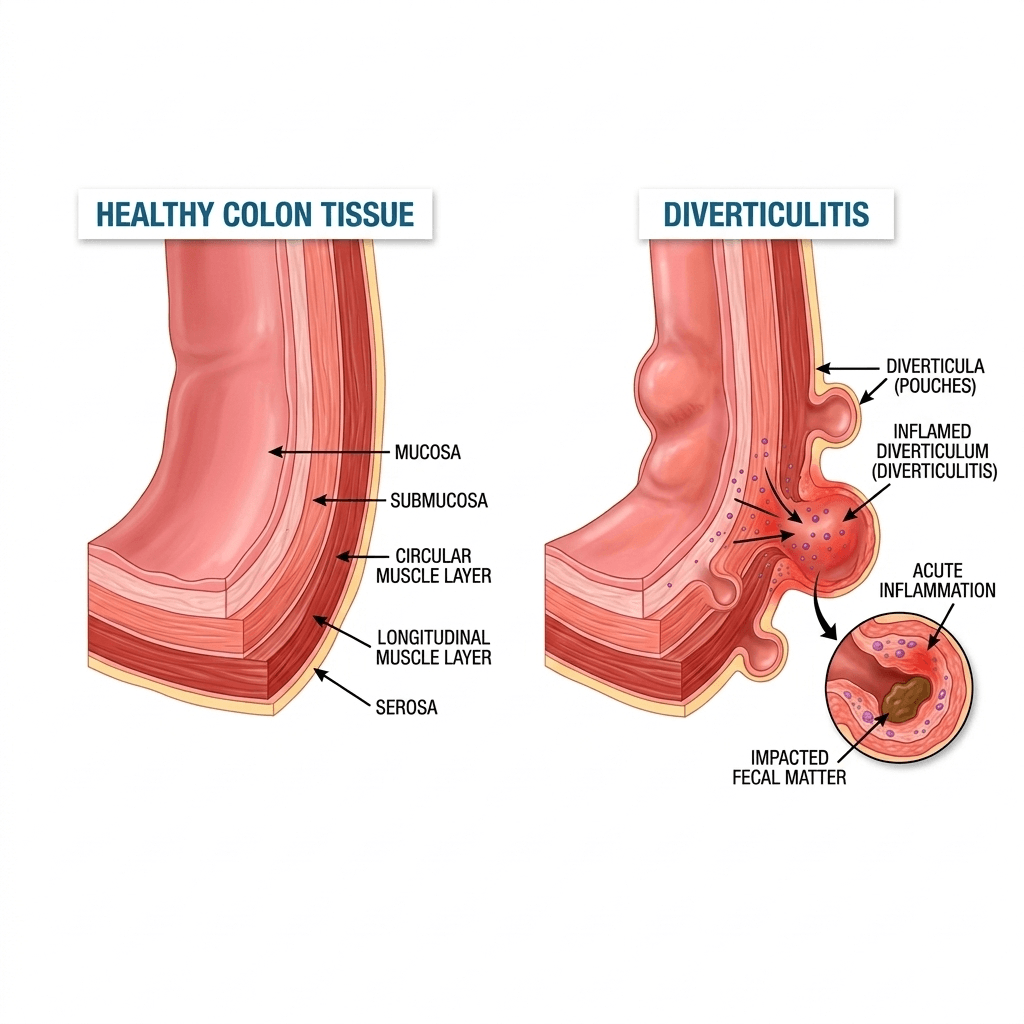
Diverticula are small pouches that form in the wall of the large bowel, more often as people get older. They usually cause no symptoms, but they can sometimes bleed, occasionally heavily, and the bleeding may be painless.[1][3]
Inflammatory bowel disease
Ulcerative colitis and Crohn's disease cause inflammation of the bowel. Symptoms can include diarrhoea mixed with blood or mucus, abdominal pain, tiredness and weight loss.[1][6]
Infection
Some bowel infections (gastroenteritis) cause bloody diarrhoea, often with fever and cramps.[1]
Stomach or duodenal ulcers
An ulcer in the stomach or the first part of the small intestine can bleed, which usually shows up as black, tarry stool rather than red blood. H. pylori infection and anti-inflammatory painkillers (NSAIDs) are common causes.[7] Read more in our article on stomach ulcers and H. pylori.
Bowel polyps and colorectal cancer
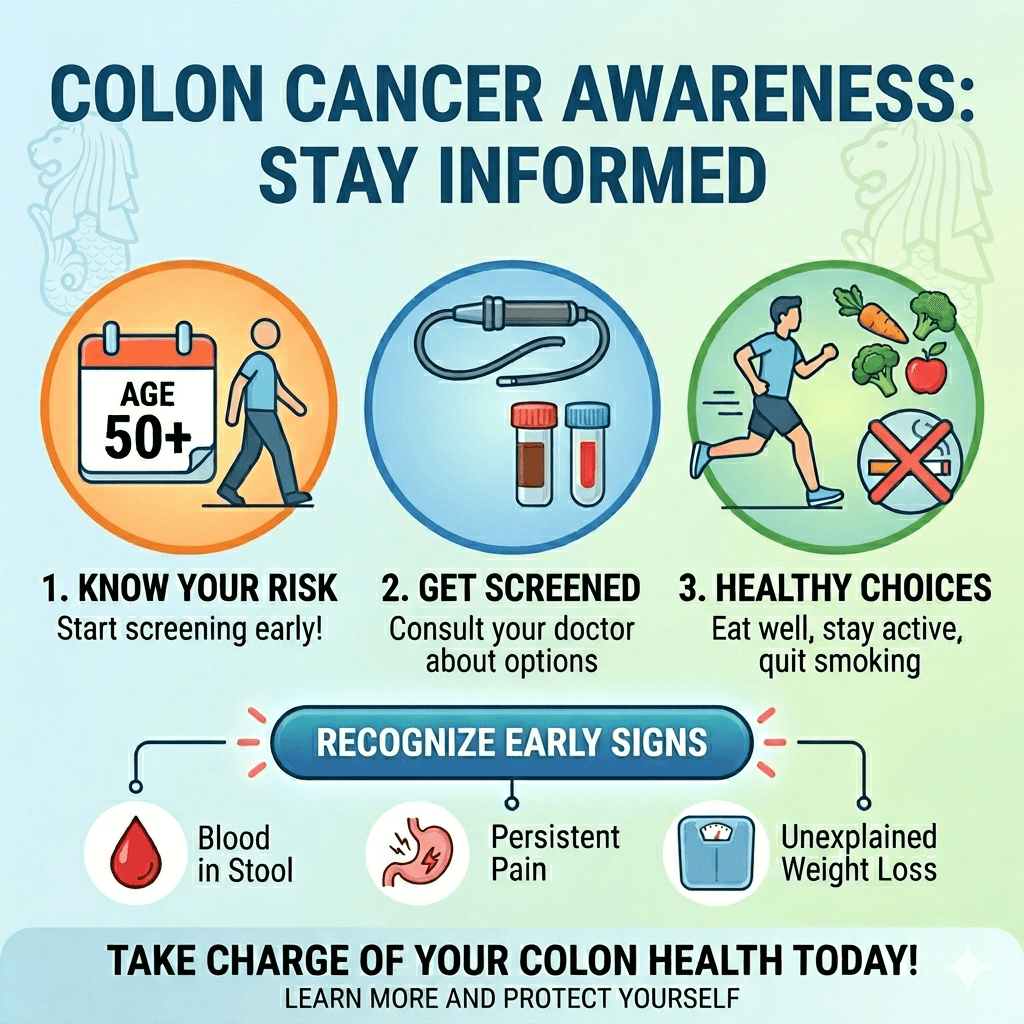
Polyps are small growths on the lining of the bowel. Most are harmless, but some can turn into cancer over time. Both polyps and colorectal cancer can bleed, sometimes only in tiny amounts that you cannot see.[2][8] In Singapore, colorectal cancer is one of the most common cancers in both men and women.[8] Early colorectal cancer often has no symptoms, so blood in the stool should not be ignored, especially if you are over 50 or have a family history of the disease.[8] Our article on polyp removal explains how polyps are treated.
Blood in stool with no pain: is it serious?
Painless bleeding is common with piles, which often bleed without hurting. However, painless bleeding can also come from diverticular disease, polyps or colorectal cancer, which may not cause pain until later.[1][2] The absence of pain does not rule out a serious cause.
A doctor is more likely to want to investigate further if:[2][9]
- you are over 50, or the bleeding is new for you
- the blood is mixed into the stool rather than only on the paper
- you also have a change in bowel habit lasting several weeks, such as looser or more frequent stools
- you have unexplained weight loss, tiredness or signs of anaemia
- there is a family history of bowel cancer or polyps
- the bleeding keeps coming back.
When to seek urgent care
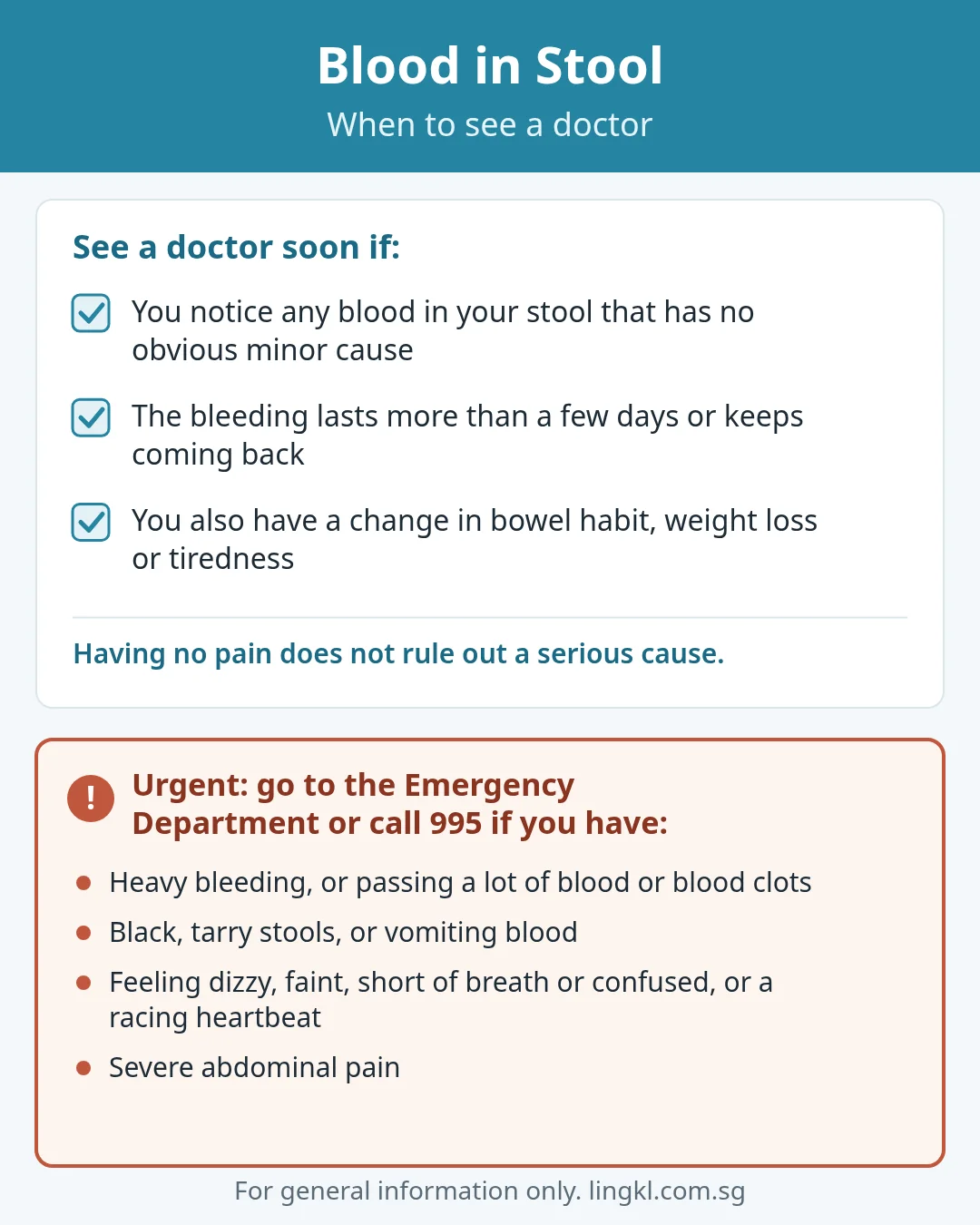
Go to the nearest Emergency Department or call 995 if you have:
- heavy bleeding, or passing a lot of blood or blood clots
- black, tarry stools, or vomiting blood or material that looks like coffee grounds
- feeling dizzy, faint, short of breath or confused, or a racing heartbeat
- severe abdominal pain
These can be signs of significant blood loss and need immediate medical attention.[1][3]
See a doctor soon (not an emergency) if: you notice any blood in your stool that has no obvious minor cause, the bleeding lasts more than a few days or keeps coming back, or you also have a change in bowel habit, weight loss or tiredness.[2][4]
How a doctor finds the cause
Your doctor will ask about your symptoms, the colour and amount of blood, your bowel habits, medicines and family history. They may then suggest:[1][2][3]
- An examination of the back passage, which may include a gentle finger examination or a short scope (proctoscopy) to check for piles or a fissure.
- Blood tests, for example to check for anaemia.
- A stool test, such as the faecal immunochemical test (FIT), which looks for hidden blood. FIT is a screening test for people without symptoms. If you can already see blood, a FIT result does not replace a proper assessment.[8][9]
- A colonoscopy, which looks at the whole of the large bowel and allows polyps to be removed or samples (biopsies) taken. Our colonoscopy patient guide explains how to prepare and what to expect.
- A gastroscopy, if the bleeding may be coming from the stomach or upper digestive tract, for example with black stools. See gastroscopy vs colonoscopy for how the two tests differ.
For information on the endoscopy procedures offered at the clinic, see our Colonoscopy and Gastroscopy service page. If you would like to discuss your symptoms with the clinic, you can send an enquiry through our contact form.
Treatment
Treatment depends on the cause. Piles and fissures often improve with a higher-fibre diet, enough fluids and avoiding straining, sometimes with creams or other treatments.[4][5] Infections, ulcers and inflammatory bowel disease are treated with medicines specific to the condition.[6][7] Polyps can usually be removed during a colonoscopy.[2] Your doctor will explain the options that apply to you once the cause is known.
Looking after your bowel health
- Eat plenty of fibre from fruit, vegetables and whole grains, and drink enough water, to help prevent constipation and straining.[4]
- Don't sit on the toilet for long periods or strain.[4]
- Know your screening age. Singapore guidance recommends colorectal cancer screening for adults at average risk from age 50, and earlier for people with a family history.[8] Screening is for people without symptoms; if you have bleeding, see a doctor instead of waiting for screening.
Frequently asked questions
Is blood in stool always serious?
No. The most common causes are piles and anal fissures, which are usually minor and treatable. However, blood in the stool can also be a sign of polyps, inflammatory bowel disease or colorectal cancer, so it is sensible to have it checked by a doctor, especially if it is new, keeps happening or comes with other symptoms.[1][2]
What does bright red blood in stool mean?
Bright red blood usually comes from near the back passage, such as from piles or a fissure. It can also come from the lower bowel, so a doctor may still suggest further tests depending on your age and other symptoms.[1][3]
Should I worry about blood in stool with no pain?
Painless bleeding is common with piles, but it can also come from polyps, diverticular disease or bowel cancer. Having no pain does not rule out a serious cause, so see a doctor if it does not settle or keeps coming back.[1][2]
What do black stools mean?
Black, tarry stools can be a sign of bleeding in the stomach or upper digestive tract and need prompt medical attention. Iron tablets and some stomach medicines can also turn stools black without bleeding.[1][3]
When should I go to the Emergency Department for rectal bleeding?
Go to the Emergency Department or call 995 if you have heavy bleeding, pass clots, have black tarry stools or vomit blood, or feel faint, dizzy or short of breath.[1][3]
Can a FIT test check blood in my stool?
FIT is a screening test for people without symptoms. If you can already see blood in your stool, a normal FIT result does not rule out a problem, so see a doctor for an assessment.[8][9]
Sources
- NHS. Bleeding from the bottom (rectal bleeding). https://www.nhs.uk/symptoms/bleeding-from-the-bottom-rectal-bleeding/
- NHS. Bowel cancer: Symptoms. https://www.nhs.uk/conditions/bowel-cancer/symptoms/
- National Institute of Diabetes and Digestive and Kidney Diseases (NIDDK). Symptoms & Causes of GI Bleeding. https://www.niddk.nih.gov/health-information/digestive-diseases/gastrointestinal-bleeding/symptoms-causes
- NHS. Piles (haemorrhoids). https://www.nhs.uk/conditions/piles-haemorrhoids/
- NHS. Anal fissure. https://www.nhs.uk/conditions/anal-fissure/
- NHS. Ulcerative colitis. https://www.nhs.uk/conditions/ulcerative-colitis/
- NHS. Stomach ulcer. https://www.nhs.uk/conditions/stomach-ulcer/
- HealthHub (HPB). Colorectal Cancer: Risk Factors, Symptoms and Screening Methods. https://www.healthhub.sg/health-conditions/colorectalcancer
- HealthHub. Understanding More About Healthier SG Screening (FAQ). https://www.healthhub.sg/programmes/healthiersg-screening/screening-faq
Need to see a specialist? Book a consultation with Dr Ling Khoon Lin at Mount Elizabeth Medical Centre.
make an appointment