Last updated: 3 Nov 2026
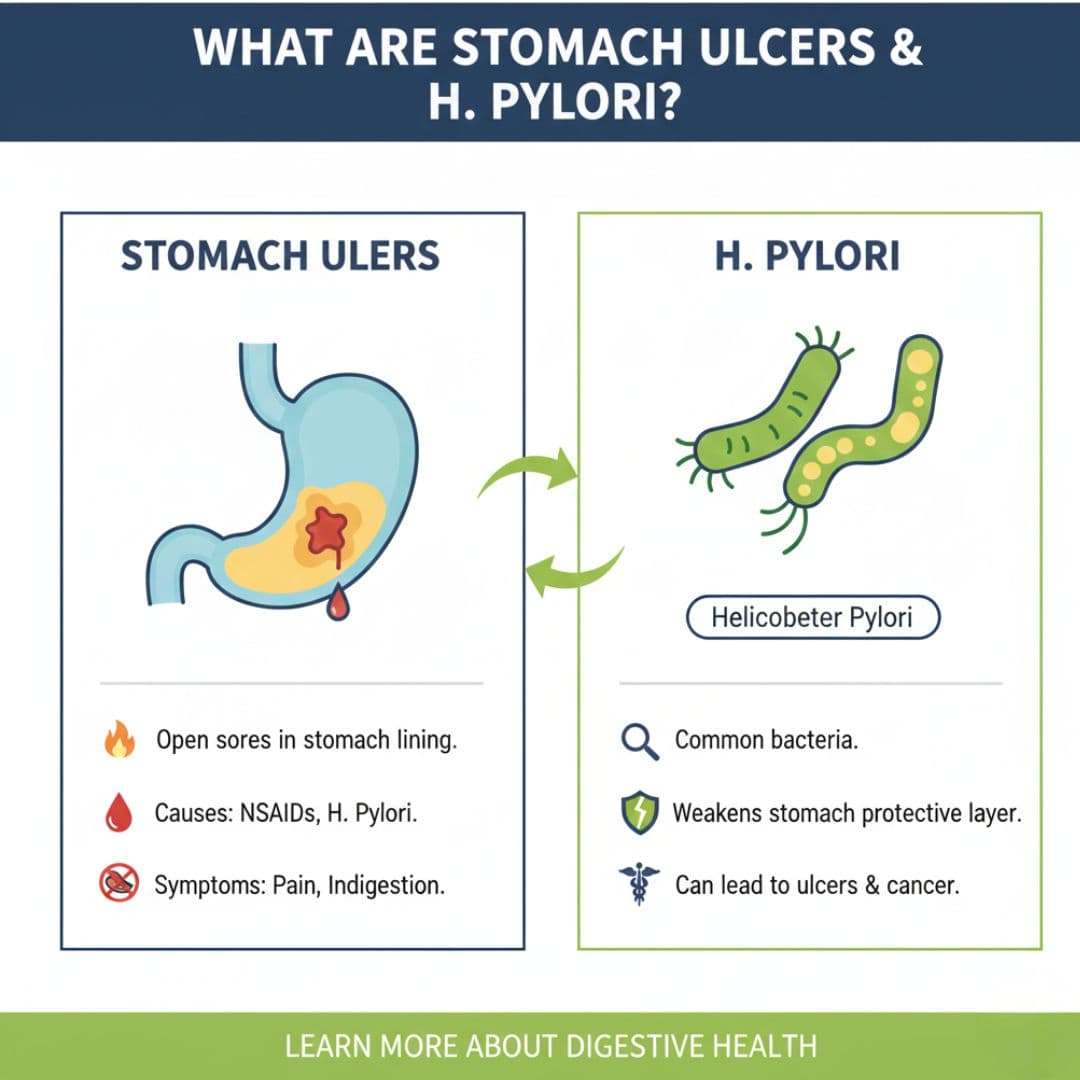
A gnawing or burning pain in the upper tummy is often brushed off as "gastric" or simple indigestion. Sometimes, though, the cause is a stomach ulcer: an open sore in the lining of the stomach or the first part of the small intestine (the duodenum).[1][2] Many ulcers are linked to a common stomach infection called Helicobacter pylori (H. pylori) or to anti-inflammatory painkillers, and both causes can be treated.[1][3] This guide to stomach ulcers for readers in Singapore explains the symptoms, causes, tests and how H. pylori treatment works.
What is a stomach ulcer?
The stomach makes strong acid to digest food. Normally, a layer of mucus protects the lining from that acid. If the protective layer is weakened, acid can damage the tissue underneath and form an ulcer.[1][2]
Doctors use the term peptic ulcer for ulcers in either the stomach (gastric ulcer) or the duodenum (duodenal ulcer). They have similar causes and are diagnosed and treated in similar ways.[1][2]
Stomach ulcer symptoms
Some people with an ulcer have no symptoms at all until a complication develops.[3] When symptoms do happen, the main one is stomach pain:[1][3]
- usually in the upper part of the tummy, anywhere between the belly button and the breastbone
- often dull or burning
- may come and go, and is often worse at night or when the stomach is empty
- in some people it eases briefly after eating; in others, eating makes it worse.
Other symptoms can include:[1][3]
- indigestion and heartburn
- bloating and belching
- feeling full very quickly, or uncomfortably full after a meal
- feeling sick (nausea) or vomiting.
Stomach pain has many possible causes, so these symptoms don't confirm an ulcer on their own. Acid reflux can cause heartburn too; our article on GERD and acid reflux treatment explains that condition. Pain in the upper right tummy after fatty meals can also come from gallstones.
Warning signs that need urgent care
An ulcer can bleed or, less often, wear a hole through the stomach wall (perforation). Call 995 or go to the nearest Emergency Department if you:[1][3]
- vomit blood, or your vomit looks like coffee grounds
- have black, sticky, tarry stools, or blood in your stools
- have sudden, sharp or severe tummy pain that doesn't go away, or your tummy is very painful to touch
- feel dizzy or faint, or have a racing pulse.
See a doctor soon if you have ulcer symptoms together with weight loss you can't explain, loss of appetite, difficulty or pain when swallowing, repeated vomiting or a feeling of a lump in your tummy.[1]
What causes stomach ulcers?
The two most common causes are:[1][3]
- H. pylori infection. H. pylori is a bacterium that can live in the stomach lining. It breaks down urea, which helps it survive in stomach acid (this is what the breath test detects), and over time it can weaken the stomach's protective layer.[2][4] It is thought to spread through contact with an infected person's saliva, vomit or stool, or through contaminated food or water.[3]
- Anti-inflammatory painkillers (NSAIDs), such as aspirin, ibuprofen and naproxen. The risk is higher with long-term use, high doses, taking more than one NSAID, or taking them alongside certain other medicines or with an H. pylori infection.[3]
Ulcers are also more common in people who smoke, and the risk increases with age.[1] Less common causes include other infections, some medicines taken with NSAIDs (such as corticosteroids) and conditions such as Crohn's disease.[3] Stress and spicy food are not the main causes, although stress, and trigger foods such as fatty or spicy food, coffee or chocolate, can make symptoms worse.[1][3]
Long-term H. pylori infection is also linked with a higher risk of stomach cancer, which is one reason doctors look for it and treat it.[4][5]
How a stomach ulcer is diagnosed
Your doctor will ask about your symptoms, the medicines you take (especially NSAIDs), any past ulcers or H. pylori infection, and family history of ulcers or stomach cancer, and will examine your tummy.[2] Tests aim to confirm the ulcer, find its cause and check for complications.
Checking for H. pylori with a breath test
The urea breath test is one of the most common non-invasive ways to check for H. pylori. You swallow a tablet, capsule or drink containing specially labelled urea, then breathe into a bag or tube. If H. pylori is present, it breaks down the urea and the labelled carbon shows up in your breath.[2][6] A breath test can show whether H. pylori is present, but it can't show the ulcer itself.
Some medicines can affect the result, so follow the instructions you're given before the test. Our article on how the H. pylori breath test works explains the test and other ways to check for the infection.
Stool and blood tests
A stool test looks for H. pylori proteins (antigens) in a stool sample. A blood test may be used to look for signs of infection or complications such as anaemia from bleeding.[2][6]
Gastroscopy
A gastroscopy (upper endoscopy) uses a thin, flexible tube with a camera, passed through the mouth, to look directly at the lining of the food pipe, stomach and duodenum. It can confirm an ulcer, and small tissue samples (biopsies) can be taken to test for H. pylori and to rule out other conditions, including cancer.[1][2] A gastroscopy may be advised if you have warning signs, if symptoms continue, or depending on your age and history.[2] It can also be used to treat a bleeding ulcer.[2]
Gastroscopy is one of the procedures performed at the clinic; see our colonoscopy and gastroscopy page for more about the procedure, or gastroscopy vs colonoscopy for how the two tests differ.
H. pylori treatment in Singapore
Treatment aims to heal the ulcer and deal with its cause so it is less likely to come back.[7]
Clearing the infection
H. pylori is treated with a combination of medicines, most often:[7]
- two or more antibiotics
- a proton pump inhibitor (PPI), which reduces stomach acid so the lining can heal
- sometimes bismuth subsalicylate.
Antibiotic resistance is a concern. Your doctor may avoid antibiotics you've taken before, because H. pylori may have become resistant to them.[7] Take every dose exactly as prescribed: stopping early can allow some bacteria to survive and become resistant.[7]
After treatment, a follow-up test, often a breath test or stool test, checks that the infection has cleared. If H. pylori is still present, a different combination of medicines may be used.[7] The exact medicines, how long you take them and when you are retested are decided at the consultation.
Ulcers caused by NSAIDs
If an NSAID is the cause, your doctor may suggest stopping it, switching to a different painkiller, using a lower dose or adding a PPI to protect the stomach. Don't stop a prescribed medicine, such as low-dose aspirin for your heart, without talking to your doctor first.[3][7]
If an ulcer doesn't heal or comes back
Most ulcers heal with medicine and treatment of the cause. If one doesn't, or returns, your doctor will check for an ongoing H. pylori infection or other factors and may advise stopping smoking, which can slow healing.[7]
Looking after your stomach
Alongside treatment, these steps may help ease symptoms:[1]
- stop smoking, if you smoke
- cut down on alcohol
- eat smaller meals and keep to a healthy weight
- avoid foods or drinks that trigger your symptoms, which can include fatty or spicy foods, coffee and chocolate
- take steps to manage stress
- check with a doctor or pharmacist before taking anti-inflammatory painkillers.
When to see a doctor
See a doctor if you have indigestion that doesn't settle with treatment, stomach pain that keeps coming back, or if you need to take NSAIDs regularly and have stomach symptoms.[1] Seek urgent care for the warning signs above.
H. pylori gastritis is among the conditions diagnosed and treated by Dr Ling Khoon Lin, a gastroenterologist in Singapore's Mount Elizabeth Medical Centre, as part of the clinic's gastroenterology and liver services. Questions about tests, medicines or next steps are covered at the consultation; you can send them through our contact form or request a consultation with the appointment form.
Frequently asked questions
What does stomach ulcer pain feel like?
Usually a dull or burning pain in the upper tummy, between the belly button and breastbone. It may come and go and is often worse at night or on an empty stomach.[1][3]
What is the most common cause of a stomach ulcer?
The most common causes are H. pylori infection and anti-inflammatory painkillers (NSAIDs) such as aspirin and ibuprofen.[1][3]
Can stress or spicy food cause a stomach ulcer?
They are not the main causes. The main causes are H. pylori and NSAIDs, but stress and trigger foods can make symptoms worse.[1][3]
How is H. pylori tested for?
With a urea breath test, a stool test or, during a gastroscopy, a biopsy of the stomach lining. Our H. pylori breath test article explains the breath test in more detail.[2][6]
How is H. pylori treated?
With a combination of antibiotics and an acid-reducing medicine (a PPI), sometimes with bismuth. A follow-up test checks that the infection has cleared.[7]
Do I need a gastroscopy for a stomach ulcer?
Not always. A gastroscopy may be advised if you have warning signs, symptoms that don't settle, or depending on your age and medical history. Your doctor will discuss whether you need one.[2]
When is stomach pain an emergency?
Get urgent help if you vomit blood or material like coffee grounds, pass black or bloody stools, have sudden severe tummy pain, or feel faint.[1][3]
Sources
- NHS. Stomach ulcer. https://www.nhs.uk/conditions/stomach-ulcer/
- National Institute of Diabetes and Digestive and Kidney Diseases (NIDDK). Diagnosis of Peptic Ulcers (Stomach or Duodenal Ulcers). https://www.niddk.nih.gov/health-information/digestive-diseases/peptic-ulcers-stomach-ulcers/diagnosis
- NIDDK. Symptoms & Causes of Peptic Ulcers (Stomach or Duodenal Ulcers). https://www.niddk.nih.gov/health-information/digestive-diseases/peptic-ulcers-stomach-ulcers/symptoms-causes
- MedlinePlus (US National Library of Medicine). Helicobacter pylori Infections. https://medlineplus.gov/helicobacterpyloriinfections.html
- National Cancer Institute. Helicobacter pylori (H. pylori) and Cancer. https://www.cancer.gov/about-cancer/causes-prevention/risk/infectious-agents/h-pylori-fact-sheet
- MedlinePlus. Helicobacter pylori (H. pylori) Tests. https://medlineplus.gov/lab-tests/helicobacter-pylori-h-pylori-tests/
- NIDDK. Treatment for Peptic Ulcers (Stomach or Duodenal Ulcers). https://www.niddk.nih.gov/health-information/digestive-diseases/peptic-ulcers-stomach-ulcers/treatment
Need to see a specialist? Book a consultation with Dr Ling Khoon Lin at Mount Elizabeth Medical Centre.
make an appointment