Last updated: 23 Oct 2026
Gastroscopy and colonoscopy are both types of endoscopy: tests that use a thin, flexible tube with a light and camera at its tip to look inside the digestive tract.[1][2] The main difference is which end of the digestive tract they examine. A gastroscopy looks at the upper part, from the food pipe to the start of the small intestine, through the mouth. A colonoscopy looks at the large bowel through the back passage.[1][2] This guide compares the two tests side by side and explains when a doctor may suggest one, the other, or both.
For information on the endoscopy procedures offered at the clinic, see our Colonoscopy and Gastroscopy service page.
The difference at a glance
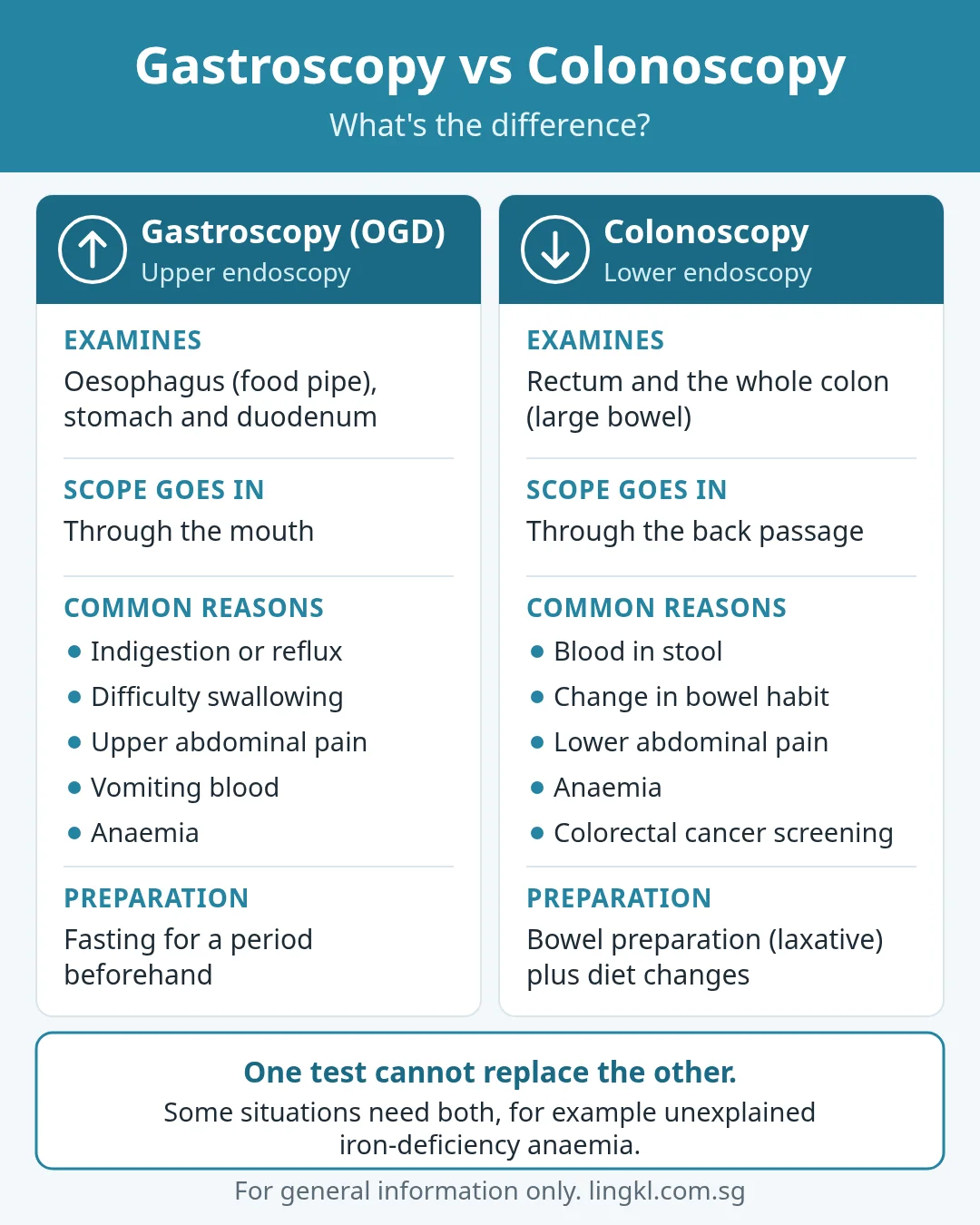
| Gastroscopy (OGD) | Colonoscopy | |
|---|---|---|
| Also called | Oesophago-gastro-duodenoscopy (OGD), upper endoscopy | Lower endoscopy |
| What it examines | Oesophagus (food pipe), stomach and duodenum (first part of the small intestine)[1] | Rectum and the whole colon (large bowel), sometimes the end of the small intestine[2] |
| How the scope goes in | Through the mouth | Through the back passage (anus) |
| Typical reasons | Indigestion, reflux, difficulty swallowing, upper abdominal pain, vomiting blood, anaemia, H. pylori-related problems[1][3] | Blood in stool, change in bowel habit, lower abdominal pain, anaemia, colorectal cancer screening, polyp follow-up[2][4] |
| Preparation | Fasting for a period beforehand[1] | Bowel preparation (laxative) to empty the bowel, plus diet changes[2] |
| Sedation | Throat spray, sedation, or both[1] | Usually sedation or pain relief[2] |
| Can samples be taken? | Yes, biopsies; some treatments such as stopping bleeding[1] | Yes, biopsies, and polyps can usually be removed[2] |
Your care team will give you your personal preparation instructions and explain what applies to you.
What is a gastroscopy?
A gastroscopy (often called an OGD in Singapore) uses a thin scope passed through the mouth and down the throat to look at the lining of the oesophagus, stomach and duodenum.[1][3]
When a gastroscopy may be recommended
A doctor may suggest a gastroscopy to look for the cause of:[1][3]
- persistent indigestion, heartburn or acid reflux
- difficulty or pain when swallowing
- upper abdominal pain
- persistent nausea or vomiting
- vomiting blood or passing black, tarry stools
- unexplained anaemia or weight loss.
It can find problems such as inflammation of the food pipe (oesophagitis), stomach or duodenal ulcers, H. pylori-related changes, and less commonly, cancer.[1][3] Biopsies can be taken to test for H. pylori and other conditions.[1] Related reading: GERD and acid reflux and stomach ulcers and H. pylori.
What it feels like
You will be asked not to eat or drink for a period before the test so that your stomach is empty.[1] You may be offered a local anaesthetic throat spray, sedation, or both. A mouth guard protects your teeth, and the scope does not affect your breathing. Some people gag briefly as the scope passes, and you may have a mild sore throat or bloating afterwards.[1]
What is a colonoscopy?
A colonoscopy uses a longer scope passed through the back passage to look at the lining of the rectum and colon.[2][5]
When a colonoscopy may be recommended
A doctor may suggest a colonoscopy:[2][4]
- to investigate blood in the stool, a lasting change in bowel habit, lower abdominal pain, or unexplained anaemia or weight loss
- to screen for colorectal cancer in people without symptoms, or after a positive stool test (FIT)
- to follow up after polyps have been removed.
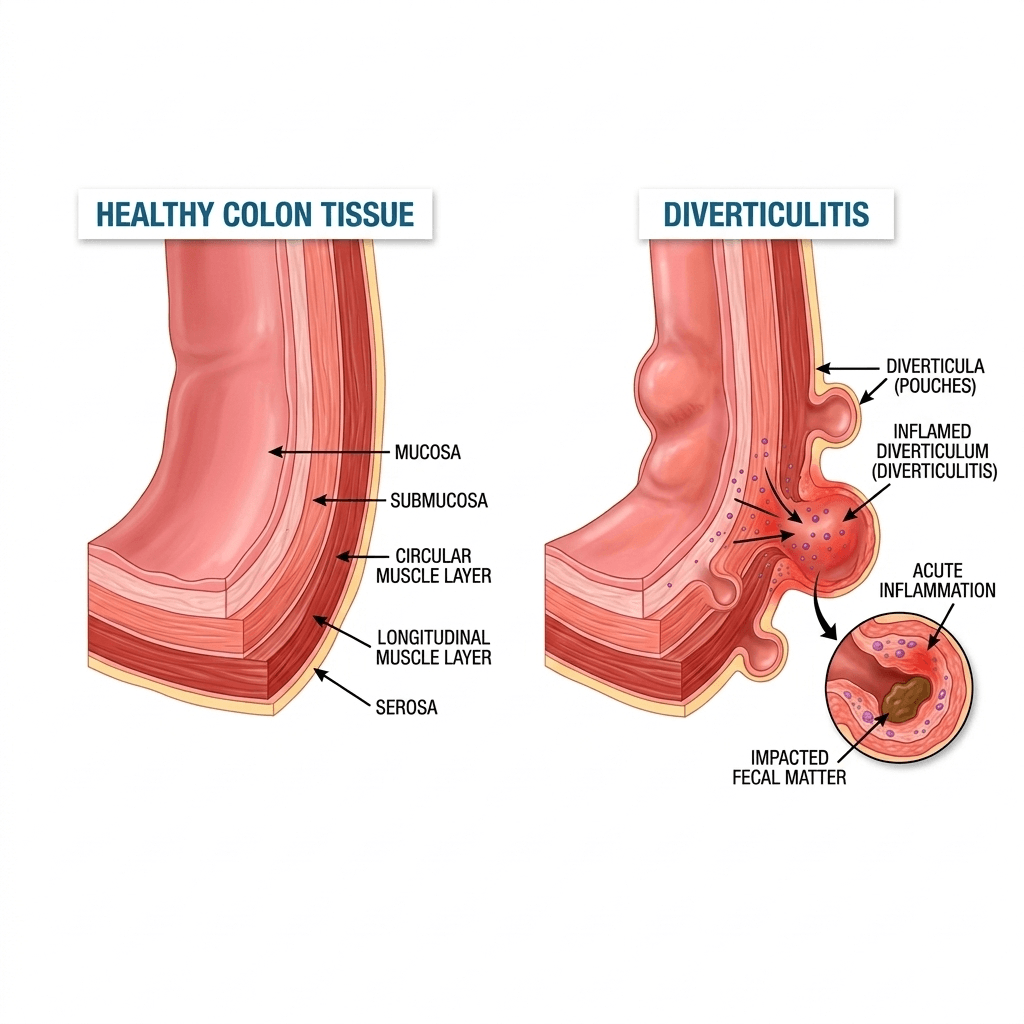
It can show inflammation, ulcers, diverticular disease, polyps and cancer, and most polyps can be removed during the same test.[2][5] Our polyp removal article explains more.
What it feels like
The bowel needs to be completely empty, so you will take a bowel-prep laxative and change your diet beforehand, following the instructions you are given.[2][5] Most people have sedation through a drip and feel relaxed. Air or gas is used to open up the bowel, so cramping or bloating is common during and shortly after the test.[2]
For a detailed guide to screening ages, preparation and recovery, read our colonoscopy patient guide.
Which test do I need?
The choice depends mainly on your symptoms and where in the digestive tract the problem is likely to be.[1][2]
- Upper symptoms (heartburn, indigestion, swallowing problems, upper abdominal pain, black stools) usually point towards a gastroscopy.
- Lower symptoms (blood in the stool, change in bowel habit, lower abdominal pain) and colorectal cancer screening usually point towards a colonoscopy.
- Some situations need both, for example unexplained iron-deficiency anaemia, where bleeding could come from either the upper or lower digestive tract.[6]
A gastroscopy does not examine the colon, and a colonoscopy does not examine the stomach. One test cannot replace the other.[1][2] Your doctor will recommend the right test after assessing your symptoms and history.
When both tests are needed
When both tests are needed, as in the investigation of unexplained iron-deficiency anaemia,[6] they may be arranged for the same visit. Preparation then follows the colonoscopy requirements, because the bowel still needs to be emptied.[2] Whether a combined session suits you, and how to prepare for it, will be explained by your care team. If you have questions about your own situation, you can send them through our contact form.
Risks
Both are common procedures, and serious complications are uncommon. Possible risks include a reaction to sedation, bleeding (especially if a biopsy is taken or a polyp is removed), and rarely a tear (perforation) in the wall of the digestive tract.[1][2] Your doctor will explain the risks that apply to you before you give consent.
When to seek urgent care
After either test, seek urgent medical care (Emergency Department or call 995) if you have:
- severe or worsening abdominal, chest or neck pain
- vomiting blood, or heavy or worsening bleeding from the back passage
- black, tarry stools
- fever or chills, or difficulty breathing or swallowing
Don't wait for a scheduled test if you notice vomiting blood, black stools, heavy rectal bleeding, or feeling faint or dizzy. These need immediate attention.[1][2]
Frequently asked questions
What is the main difference between a gastroscopy and a colonoscopy?
A gastroscopy examines the oesophagus, stomach and duodenum through the mouth. A colonoscopy examines the rectum and colon through the back passage. They look at different parts of the digestive tract and are used for different symptoms.[1][2]
Is OGD the same as gastroscopy?
Yes. OGD stands for oesophago-gastro-duodenoscopy, the full name for a gastroscopy. It is also called an upper endoscopy.[1]
Which is more uncomfortable, a gastroscopy or a colonoscopy?
It varies from person to person. A gastroscopy can cause brief gagging. A colonoscopy needs bowel preparation, which many people find the hardest part. Sedation is commonly used for both.[1][2]
Can a gastroscopy detect colon cancer?
No. A gastroscopy does not reach the colon. Colorectal cancer screening and investigation of lower bowel symptoms need a colonoscopy or another test of the lower bowel.[2][4]
Can both tests be done at the same time?
They may be. When both tests are needed, for example to investigate unexplained iron-deficiency anaemia, they may be arranged for the same visit. Your care team will explain whether this suits you and how to prepare.[2][6]
Do I need bowel preparation for a gastroscopy?
No. A gastroscopy only needs you to fast for a period beforehand. Bowel preparation is needed for a colonoscopy, including when both tests are done together.[1][2]
Sources
- NHS. Gastroscopy. https://www.nhs.uk/tests-and-treatments/gastroscopy/
- NHS. Colonoscopy. https://www.nhs.uk/tests-and-treatments/colonoscopy/
- NIDDK. Upper GI Endoscopy. https://www.niddk.nih.gov/health-information/diagnostic-tests/upper-gi-endoscopy
- HealthHub (HPB). Colorectal Cancer: Risk Factors, Symptoms and Screening Methods. https://www.healthhub.sg/health-conditions/colorectalcancer
- National Institute of Diabetes and Digestive and Kidney Diseases (NIDDK). Colonoscopy. https://www.niddk.nih.gov/health-information/diagnostic-tests/colonoscopy
- Snook J, et al. British Society of Gastroenterology guidelines for the management of iron deficiency anaemia in adults. Gut 2021;70:2030–2051. https://pmc.ncbi.nlm.nih.gov/articles/PMC8515119/ (doi:10.1136/gutjnl-2021-325210)
Need to see a specialist? Book a consultation with Dr Ling Khoon Lin at Mount Elizabeth Medical Centre.
make an appointment