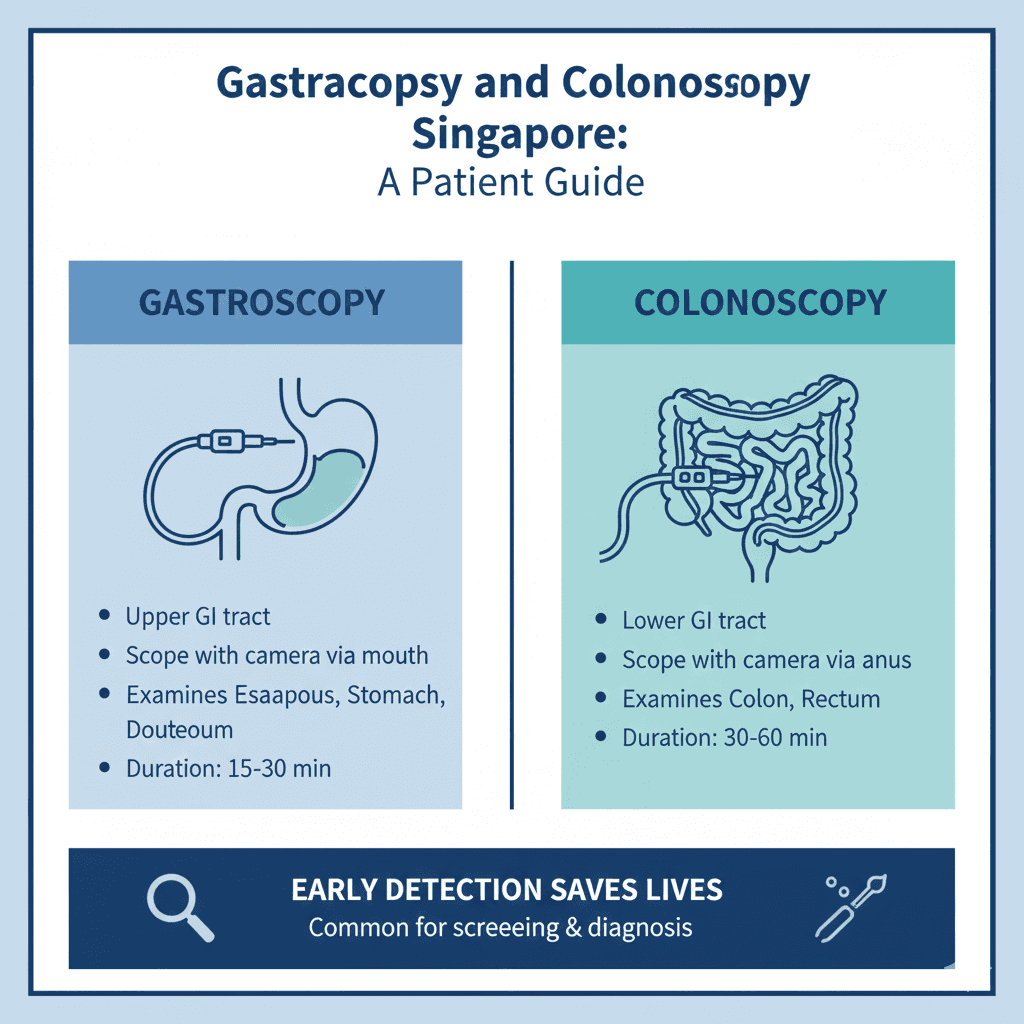
A colonoscopy is a test that lets a doctor look at the inside lining of the large bowel (colon and rectum) using a thin, flexible tube with a camera at its tip, called a colonoscope.[1][2] This guide explains who may be advised to have one, the screening ages used in Singapore, how to prepare, and what usually happens on the day and afterwards.
For information on the procedures offered at the clinic, see our Colonoscopy and Gastroscopy service page.
Why a colonoscopy may be recommended
A colonoscopy is used for two broad purposes.
1. To investigate symptoms. A doctor may suggest a colonoscopy to look for the cause of symptoms such as bleeding from the back passage or blood in the stool, a lasting change in bowel habit (diarrhoea or constipation), abdominal pain, or unexplained weight loss or tiredness.[1][2] It can show inflammation, ulcers, polyps and cancer.[1]
2. To screen for colorectal cancer. Screening means testing people who have no symptoms. Colorectal cancer usually has no symptoms in its early stages,[3] and it develops from a pre-cancerous phase (adenoma) over a relatively long period, which is why regular screening can reduce deaths from the disease.[4] During a colonoscopy, polyps can usually be removed or sampled at the same time.[2][5]
In Singapore, colorectal cancer is the second most common cancer in both men and women, with more than 12,000 new cases diagnosed from 2018 to 2022.[5]
What age should you consider colonoscopy in Singapore?
Singapore's recommendations depend on your level of risk.
Average risk
You are generally considered average risk if you have no symptoms, and either no family history of colorectal cancer, or a family history only in relatives who are not first-degree (not parents, siblings or children) or who were diagnosed after age 60.[3]
For average-risk adults, screening is recommended from age 50, using either:[3][6][7]
- a Faecal Immunochemical Test (FIT) once a year, or
- a colonoscopy once every 5 to 10 years.
FIT is a home stool test that detects small amounts of blood not visible to the eye. A positive FIT does not mean you have cancer, but further tests, usually a colonoscopy, are needed to find the cause.[6][8] Under Healthier SG Screening, eligible Singapore citizens and PRs aged 50 and above can obtain FIT kits through their Healthier SG clinic or CHAS GP. Colonoscopy is not covered under Healthier SG Screening.[6][7]
You may see different ages quoted online. For example, the US Preventive Services Task Force recommends screening from age 45 for adults in the United States.[9] Singapore's national guidance currently uses age 50 for average-risk adults.[3][7] Your doctor can advise which applies to you.
Increased or high risk
People with certain risk factors are usually advised to have colonoscopy, starting earlier and repeated more often. According to HealthHub:[3][10]
| Situation | When to start | How often |
|---|---|---|
| A first-degree relative diagnosed with colorectal cancer at age 60 or younger, or two or more first-degree relatives | Age 40, or 10 years before the youngest case in the family, whichever is earlier | Every 5 years |
| A first-degree relative diagnosed after age 60 | From age 50 | Every 5–10 years |
| Personal history of polyps, colorectal cancer, long-standing inflammatory bowel disease, or a hereditary syndrome (e.g. Lynch syndrome / HNPCC, familial adenomatous polyposis) | As advised by your doctor | As advised by your doctor |
If any of these apply to you, discuss your screening plan with a doctor rather than waiting until 50.
How to prepare for a colonoscopy
The aim of preparation is to empty the bowel completely, because any stool left in the colon can hide the lining from view.[1] If the bowel is not clean enough, the test may need to be repeated.[2] Preparation differs from person to person and between bowel-prep products. Your care team will go through your personal preparation plan with you, so follow the instructions you are given.
At the consultation
- all medicines, vitamins and supplements you take. Some medicines, such as blood thinners, iron tablets and diabetes medicines, may need adjusting before a colonoscopy. Your care team will advise you at your consultation. Do not stop any medicine on your own.
- any heart, kidney or lung conditions, and previous reactions to sedation
- whether you are, or could be, pregnant.
In the days before
You may be asked to avoid high-fibre foods such as whole grains, raw vegetables, beans, nuts and seeds for a short period.[1] How long depends on your preparation plan.
Shortly before the procedure
- You may need to switch to a clear-liquid diet: water, clear broth, plain tea or coffee without milk, pulp-free apple or white grape juice, and light-coloured jelly or isotonic drinks. Avoid red- or purple-coloured drinks.[1]
- Take the bowel-prep laxative exactly as instructed by your care team.[1]
- The laxative causes diarrhoea, so stay at home near a toilet.[1][2]
- If side effects stop you finishing the preparation, contact the clinic.[1]
On the day
- Stop eating and drinking at the time you were given.[2]
- Arrange for someone to take you home. You should not drive for 24 hours after sedation.[2]
What happens during the colonoscopy
- Before the procedure: you change into a gown, and a small tube (IV line) is placed in your arm or hand so that sedation or pain relief can be given.[1][2]
- During the procedure: you lie on your side while the colonoscope is passed through the back passage into the rectum and along the colon. Air or gas is used to open up the bowel, so you may feel bloated or crampy. If polyps are found, they can be removed or sampled, which you will not feel.[1][2]
- How long it takes: the test usually takes around 20 to 45 minutes,[2][3] though you may be at the centre for around two hours in total.[2]
After the colonoscopy
- You will rest in a recovery area until the sedation wears off.[2]
- Bloating or cramps for a few hours afterwards is common. If a polyp was removed, you may see a small amount of blood in your stool for a couple of days.[2]
- Your doctor will usually tell you on the day whether any polyps were removed or biopsies taken. Results of any biopsies are not available straight away, and your doctor will explain how they will be followed up.
- Your doctor will advise when you need your next colonoscopy, based on what was found.[10]
Risks
Colonoscopy is a common procedure, and complications are uncommon. They can include a reaction to sedation, bleeding, and a tear in the bowel wall (perforation).[1][2] MOH has stated that about 1 in 10,000 people may have a perforation of the colon or other complications.[4] Your doctor will explain the risks that apply to you before you give consent.
When to see a doctor
Do not wait for a screening appointment if you notice:
- blood in your stool or bleeding from the back passage
- a change in bowel habit lasting several weeks
- unexplained weight loss or tiredness
- persistent abdominal pain or a lump in the abdomen
See a doctor about these even if a recent FIT result was normal.[3][8]
After a colonoscopy, seek urgent medical care if you have: heavy or worsening bleeding, severe or worsening abdominal pain, fever or chills, or vomiting that will not stop.[2]
Paying for a colonoscopy
MediSave and insurance may help with the cost of a colonoscopy, depending on your circumstances and policy.[4] The clinic can explain your options at your consultation. If you would like to discuss this, you can request an appointment through our contact form.
Frequently asked questions
At what age should I have a colonoscopy in Singapore?
For adults at average risk with no symptoms, Singapore guidance recommends colorectal cancer screening from age 50, with either a yearly FIT stool test or a colonoscopy every 5 to 10 years. People with a family history of colorectal cancer or other risk factors may be advised to start earlier, sometimes from age 40.[3][7]
Is a colonoscopy painful?
Most people are given sedation through a drip, so they are relaxed and usually feel little discomfort. Some bloating or cramping is common during and for a few hours after the test.[1][2]
How long does a colonoscopy take?
The procedure usually takes about 20 to 45 minutes, but allow around two hours at the centre for preparation and recovery.[2][3]
What can I eat before a colonoscopy?
You may be asked to eat a low-fibre diet for a short period, then switch to clear liquids such as water, clear broth, and tea or coffee without milk. Your care team will go through your personal preparation plan with you.[1]
Can I drive home after a colonoscopy?
No. If you have had sedation, you should not drive for 24 hours, so arrange for someone to take you home.[2]
Do I need to stop my medicines before a colonoscopy?
Some medicines, such as blood thinners, iron tablets and diabetes medicines, may need adjusting. Your care team will advise you at your consultation. Do not stop any medicine on your own. You can request an appointment through our contact form.[1][2]
What is the difference between a FIT test and a colonoscopy?
FIT is a home stool test that checks for hidden blood and is repeated every year. A colonoscopy looks directly at the whole colon and allows polyps to be removed, and for average-risk adults it is repeated every 5 to 10 years. A positive FIT usually needs a follow-up colonoscopy.[3][6][8]
Sources
- National Institute of Diabetes and Digestive and Kidney Diseases (NIDDK). Colonoscopy. https://www.niddk.nih.gov/health-information/diagnostic-tests/colonoscopy
- NHS. Colonoscopy. https://www.nhs.uk/tests-and-treatments/colonoscopy/
- HealthHub (HPB). Colorectal Cancer: Risk Factors, Symptoms and Screening Methods. https://www.healthhub.sg/health-conditions/colorectalcancer
- Ministry of Health Singapore. CRC screening. https://www.moh.gov.sg/newsroom/crc-screening/
- National Cancer Centre Singapore. Screening could save your life. https://www.nccs.com.sg/about-nccs/news/publications/in-good-health/issue-14/screening-could-save-your-life.newsdetails
- Singapore Cancer Society. Screening for Colorectal Cancer. https://singaporecancersociety.org.sg/screening-for-colorectal-cancer/
- Primary Care Pages (MOH). Healthier SG – Cancer Screening protocol. https://www.primarycarepages.sg/healthier-sg/care-protocols/preventive-health-care-protocols/cancer-screening
- HealthHub. Understanding More About Healthier SG Screening (FAQ). https://www.healthhub.sg/programmes/healthiersg-screening/screening-faq
- US Preventive Services Task Force. Colorectal Cancer: Screening. https://www.uspreventiveservicestaskforce.org/uspstf/recommendation/colorectal-cancer-screening
- HealthHub (NUHS). Screening for Colorectal Cancer. https://www.healthhub.sg/well-being-and-lifestyle/personal-care/screening_colorectal_cancer_nuhs
Need to see a specialist? Book a consultation with Dr Ling Khoon Lin at Mount Elizabeth Medical Centre.
make an appointment