Last updated: 31 Oct 2026
Colon polyps are small growths on the inside lining of the large bowel (colon) or back passage (rectum). They are very common, and most are harmless.[1][2] But most colorectal cancers start as a polyp, and some polyps can slowly change into cancer over time.[2] Removing a polyp, a procedure called a polypectomy, is one of the main reasons doctors look inside the bowel. This guide explains what colon polyps are, how polypectomy is done, what happens to the polyp afterwards and when to speak to a doctor.
What are colon polyps?
A polyp is a growth that sticks out from, or lies flat against, the lining of the bowel. You can have one or several.[2] Polyps are also called colonic or colorectal polyps.[1]
Types of polyps
Doctors group polyps by how their cells look under a microscope:[3]
- Adenomas (adenomatous polyps) are a common type. Most never become cancer, but adenomas are the type most often linked with colorectal cancer. Villous adenomas are more likely than tubular adenomas to change.
- Serrated polyps are less common, but some may develop into cancer over time.
- Hyperplastic polyps rarely, if ever, become cancerous.
Larger polyps carry a higher risk than small ones.[3] Because the type can't always be told by looking, removed polyps are sent to a laboratory to be examined.[1][4]
Who is more likely to have polyps?
Anyone can develop colon polyps, but they are more likely if you:[2][3]
- are older (polyps become more common with age)
- have a parent, brother or sister who has had polyps or colorectal cancer
- have inflammatory bowel disease, such as ulcerative colitis or Crohn's disease
- are overweight or smoke
- have certain inherited conditions, such as familial adenomatous polyposis (FAP) or Lynch syndrome.
If inflammatory bowel disease applies to you, our article on Crohn's disease vs ulcerative colitis explains the two conditions.
Do colon polyps cause symptoms?
Usually not. Most people with polyps feel well and don't know they have them, which is why polyps are often found during a test done for another reason or during screening.[1][5] When they do cause symptoms, larger polyps may lead to:[1][5]
- bleeding from the bottom, or blood or mucus in your poo
- a change in your usual bowel habit, such as diarrhoea or constipation
- tiredness from anaemia, if a polyp has been bleeding slowly over time
- losing weight without trying (rarely).
These symptoms have many possible causes, most of them not serious, but they should be checked. Our article on blood in stool covers the common causes and warning signs.
How colon polyps are found
Polyps can only be found with tests that look at the bowel or detect signs of it:[3][6]
- Colonoscopy: a long, thin, flexible tube with a light and camera is passed through the back passage to look at the whole colon. It is the one test that can both find and remove polyps at the same time.[6]
- Flexible sigmoidoscopy: a similar, shorter tube looks at the rectum and lower colon only.[6]
- CT colonography (virtual colonoscopy): a scan that creates images of the bowel. It can show polyps, but they can't be removed during the scan.[1][6]
- Stool tests, such as the faecal immunochemical test (FIT), look for hidden blood that could come from a polyp or cancer. A positive result is usually followed by a colonoscopy.[3]
To find out which test suits your age and risk, see our guide to colorectal cancer screening in Singapore.
What is a polypectomy?
A polypectomy is the removal of a polyp. Almost all colon polyps can be removed during a colonoscopy, without surgery, which is why it is called an endoscopic polypectomy.[4]
How colon polyp removal works
During the colonoscopy, the doctor looks closely at the bowel lining. When a polyp is found, it is removed using small tools passed through the colonoscope:[1][4]
- Snare polypectomy: a thin wire loop is placed around the polyp and tightened to cut it off. A gentle electric current may be used at the same time to seal the area.
- Forceps removal: very small polyps may be taken with tiny forceps.
You shouldn't feel the polyp being removed, and you'll usually be offered sedation or other medicine to help you relax during the colonoscopy.[1][7] Rarely, when a polyp is very large or there are many polyps, surgery to remove part of the bowel may be advised instead.[1][3]
If you'd like to know what a colonoscopy itself is like, our patient guide to colonoscopy preparation and what to expect explains it. If you're not sure how it compares with a test of the stomach, see gastroscopy vs colonoscopy. Your doctor will tell you how to prepare for your procedure, including what to do about any medicines you take.
Possible risks
Polypectomy is a routine procedure, but like any medical procedure it has some risks. Complications are rare, but can include bleeding, damage to the bowel wall (perforation) and a reaction to the sedation.[7] Your doctor will talk you through the risks that apply to you before the procedure.
After a polypectomy
What happens to the polyp?
Each removed polyp is sent to a laboratory, where a pathologist examines it to check:[1][4]
- what type of polyp it is
- whether it was removed completely
- whether there are any cancerous changes.
Your doctor will explain the results to you. If there are cancerous changes, you may need further tests or treatment, and your doctor will advise you about the next steps.[1]
Follow-up colonoscopy
Having had polyps means you are more likely to develop new ones, so your doctor may recommend a repeat colonoscopy in the future.[4] When that should be depends on things like the number, size and type of polyps removed, your age and general health, and your family history.[3] Your doctor will give you a plan based on your own results.
Warning signs after polyp removal
Contact a doctor promptly if, after a polypectomy, you have:[4]
- severe pain in your tummy
- a fever
- bleeding from your bottom that doesn't stop, or bloody bowel movements that don't get better
- dizziness or weakness.
If you are passing a lot of blood, call 995 or go to the nearest Emergency Department.
Colon cancer prevention: lowering your risk of polyps
Removing polyps before they can change can help prevent colorectal cancer.[2] There's no guaranteed way to stop polyps forming, but these steps may lower your chances:[4][3]
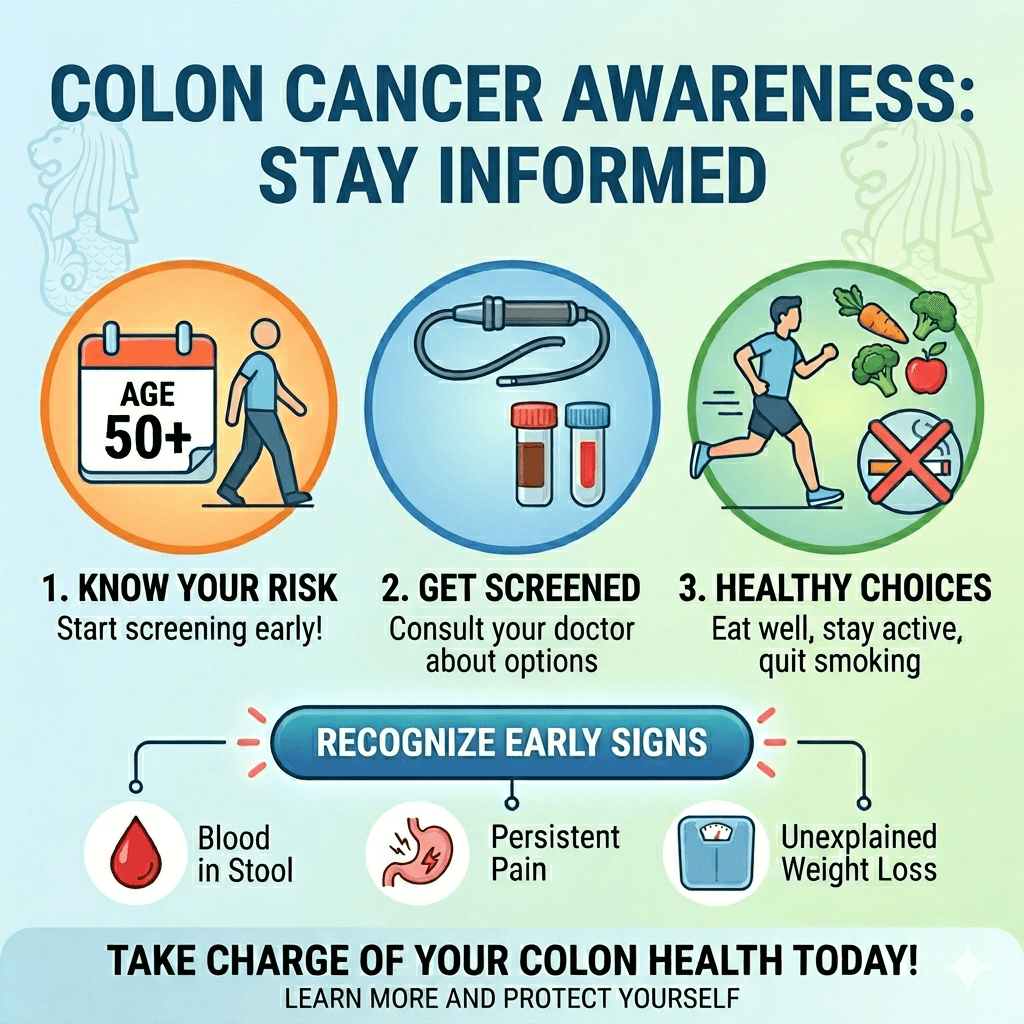
- eat more fruit, vegetables and fibre, and less red and processed meat
- be physically active
- don't smoke, and avoid or cut down on alcohol
- lose weight if you're overweight.
Some studies suggest that long-term low-dose aspirin may lower the risk in some people, but it can cause bleeding in the stomach or bowel. Don't start taking aspirin for this reason without talking to your doctor.[4]
When to see a doctor
Speak to a doctor if you notice blood or mucus in your poo, a change in your bowel habit that doesn't settle, unexplained weight loss or tiredness, or if you have a family history of polyps or bowel cancer and haven't discussed screening.[1][3]
Endoscopy, including colonoscopy with polyp removal, is part of the Colonoscopy and Gastroscopy services at the clinic of Dr Ling Khoon Lin, a gastroenterologist at Mount Elizabeth Medical Centre. If you have questions about polypectomy, you can send them through our contact form or request a consultation with the appointment form.
Frequently asked questions
What is a polypectomy?
A polypectomy is the removal of a polyp, a small growth on the lining of the bowel. In the colon, it is usually done during a colonoscopy using a wire loop or small forceps, so surgery isn't normally needed.[1][4]
Is polypectomy painful?
You shouldn't feel the polyp being removed, and you'll usually be offered medicine to help you relax. Some people feel bloated or crampy for a short while afterwards.[1][7]
Are colon polyps cancer?
Most polyps are not cancer. Some types, mainly adenomas and some serrated polyps, can change into cancer slowly over time, which is why they are removed and tested.[2][3]
Can polyps be removed during a colonoscopy?
Yes. Almost all colon polyps can be removed during a colonoscopy. A CT scan of the bowel can show polyps but can't remove them.[4][6]
Do polyps come back after removal?
People who have had polyps are more likely to develop new ones. Your doctor may advise a follow-up colonoscopy based on your results.[1][4]
Does polyp removal prevent colon cancer?
Removing polyps can help prevent colorectal cancer because most colorectal cancers start as polyps. It doesn't remove the risk completely, so follow-up and attention to symptoms still matter.[2]
What are the risks of polypectomy?
Complications are rare, but can include bleeding, damage to the bowel wall (perforation) and a reaction to the sedation. Your doctor will explain the risks before the procedure.[7]
Sources
- NHS. Bowel polyps. https://www.nhs.uk/conditions/bowel-polyps/
- National Institute of Diabetes and Digestive and Kidney Diseases (NIDDK). Definition & Facts for Colon Polyps. https://www.niddk.nih.gov/health-information/digestive-diseases/colon-polyps/definition-facts
- MedlinePlus (US National Library of Medicine). Colorectal polyps. https://medlineplus.gov/ency/article/000266.htm
- NIDDK. Treatment for Colon Polyps. https://www.niddk.nih.gov/health-information/digestive-diseases/colon-polyps/treatment
- NIDDK. Symptoms & Causes of Colon Polyps. https://www.niddk.nih.gov/health-information/digestive-diseases/colon-polyps/symptoms-causes
- NIDDK. Diagnosis of Colon Polyps. https://www.niddk.nih.gov/health-information/digestive-diseases/colon-polyps/diagnosis
- NHS. Colonoscopy. https://www.nhs.uk/tests-and-treatments/colonoscopy/
Need to see a specialist? Book a consultation with Dr Ling Khoon Lin at Mount Elizabeth Medical Centre.
make an appointment