Last updated: 5 Nov 2026
Singapore's population is ageing, and many families now care for a parent or grandparent who has tummy troubles: a smaller appetite, more wind, harder stools or new discomfort after meals. Some of these changes are common as we get older. Others are a sign of a condition that should be checked, and older adults are more likely to have the conditions that need investigating, such as bleeding from the gut, polyps and bowel cancer.[1][2]
This guide to digestive health for seniors in Singapore covers the gut problems that become more common with age, how to tell everyday changes from warning signs, and the screening that older adults are advised to have. It is written for seniors and the family members who look after them.
Why digestion changes as we get older
Bowel habits can change as we get older, and several things that often come with age can affect the gut:[3][4]
- Moving less. Spending long periods sitting or lying down is a common cause of constipation.[3]
- Eating and drinking less. A smaller appetite, dental problems or drinking less fluid can mean less fibre and water, which makes stools harder.[3]
- More medicines. Many older adults take several medicines. Some, such as opioid painkillers, iron supplements, diuretics and antacids containing aluminium or calcium, can cause or worsen constipation; others, such as anti-inflammatory painkillers (NSAIDs), can irritate the stomach or increase the risk of bleeding.[3][4][6]
- Other health conditions. Conditions such as stroke or dementia can affect swallowing, and changes in behaviour or confusion may be the only sign that an older person with dementia is uncomfortable.[3][7]
Because of this, it is easy to put every new symptom down to "old age". The sections below explain which changes are common and which need a doctor's review.
Common digestive problems in older adults
Constipation
Constipation means passing stools less often than usual, or stools that are hard, dry or difficult to pass. It is more common in people over 65.[3] In older adults it is often linked to low fibre or fluid intake, being less active, or a side effect of medicine.[3] Simple changes such as gradually adding fibre, drinking enough fluid and staying active can help, and a pharmacist can advise on laxatives. Speak to a doctor before stopping any prescribed medicine.[3]
Constipation that is new, doesn't improve, or comes with blood in the stool, weight loss, tiredness or tummy pain should be checked by a doctor.[3]
Diverticular disease
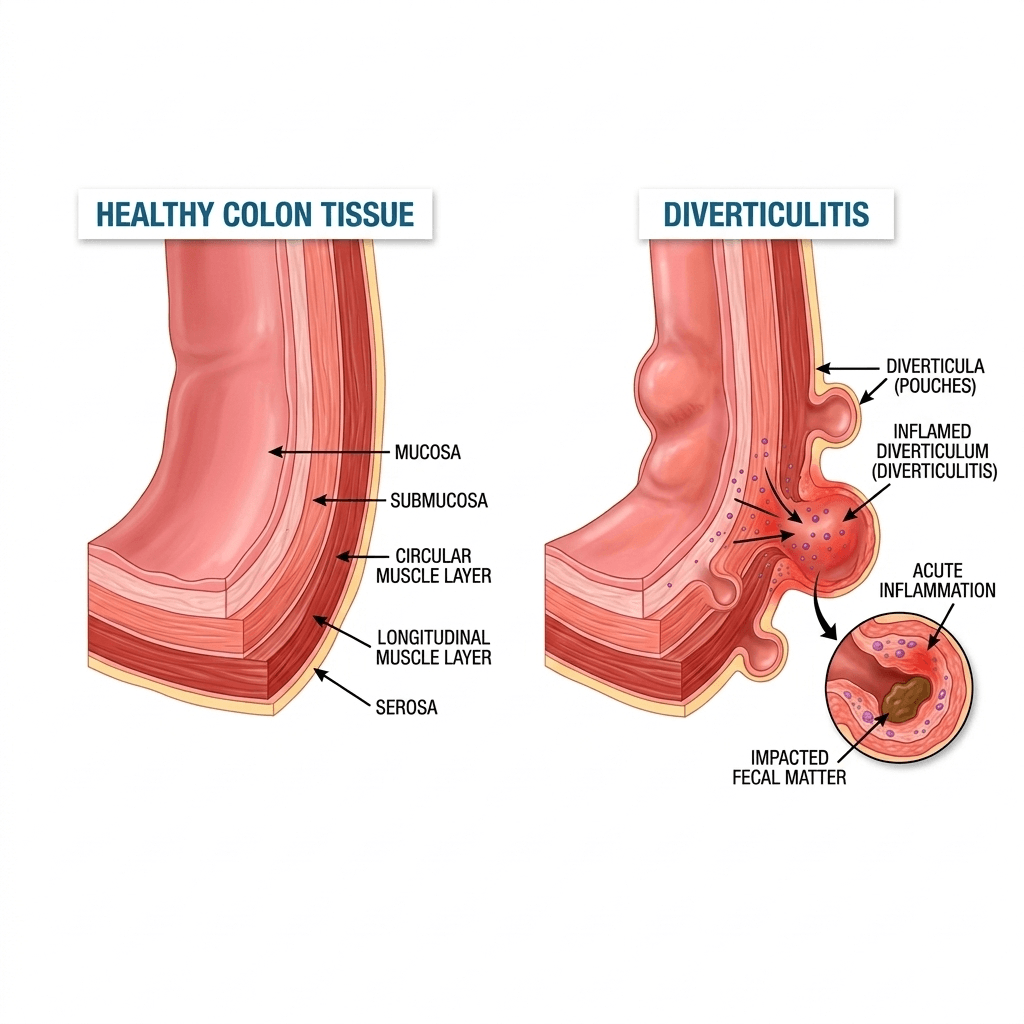
Diverticula are small pouches that form in the wall of the large bowel. Most people develop some as they get older, and most never have symptoms.[8] When they do cause problems (diverticular disease), symptoms can include pain in the lower left side of the tummy, bloating, constipation or diarrhoea, and blood in the stool.[8][9]
If the pouches become inflamed or infected (diverticulitis), the pain is usually more severe and constant, and there may be a fever.[8][9] Symptoms of diverticular disease can be similar to other bowel conditions, so tests such as a colonoscopy or a CT scan may be needed to confirm it.[8]
Indigestion, ulcers and medicines
Anti-inflammatory painkillers such as ibuprofen and aspirin are a common cause of stomach ulcers, and some older adults take aspirin long term for heart health.[6] Ulcer symptoms include burning upper tummy pain, indigestion and bloating, but some ulcers cause no symptoms until they bleed.[6] Our article on stomach ulcers and H. pylori treatment explains this in more detail. Heartburn and acid reflux are also common; see managing acid reflux and heartburn.
Swallowing difficulties
Difficulty swallowing (dysphagia) is not a normal part of ageing. It can be caused by acid reflux, certain medicines, conditions such as stroke or dementia, and less often by cancer of the food pipe.[7] Signs include coughing or choking when eating or drinking, food feeling stuck in the throat or chest, and bringing food back up.[7] Anyone with new swallowing problems should be checked, as a doctor may recommend tests such as an endoscopy.[7]
Low iron or vitamin B12
Vitamin B12 deficiency is more common in older people, affecting around 1 in 10 people aged 75 or over in the UK.[10] Causes include pernicious anaemia (an autoimmune condition that stops the stomach absorbing B12) and some medicines, including acid-reducing proton pump inhibitors (PPIs).[10] Symptoms can be vague, such as tiredness, pins and needles, a sore tongue, or memory problems and confusion.[10]
Iron deficiency anaemia can cause tiredness, breathlessness and pale skin. Slow bleeding in the stomach or bowel is a common cause, for example from NSAIDs, ulcers, inflammation, piles or, less often, bowel or stomach cancer.[5] If the reason for anaemia isn't clear, a doctor may arrange further tests to look for bleeding in the gut.[5]
Piles and bleeding from the bottom
Piles (haemorrhoids) become more common with age and are a frequent cause of bright red blood after passing a stool.[11] Bleeding from the bottom can also come from other conditions, including polyps, diverticular disease and bowel cancer, so it should always be checked in an older adult.[2][11] See our guides to haemorrhoids and blood in stool.
Is it ageing, IBS or something else?
Irritable bowel syndrome (IBS) causes symptoms such as tummy pain, bloating, wind and changes in bowel habit. These overlap with diverticular disease, constipation and other bowel conditions.[8][9] Because the risk of bowel cancer is higher after the age of 50, new bowel symptoms that begin later in life shouldn't simply be labelled as IBS without a doctor's review.[1][2] Our article on IBS vs IBD explains how IBS differs from inflammatory bowel conditions.
The table below gives a general guide. It is not a substitute for seeing a doctor.
| Area | Often a common change | Worth getting checked |
|---|---|---|
| Bowel habits | Slightly less frequent stools that improve with more fibre, fluid and activity[3] | A sudden or persistent change in bowel habit, such as new constipation, looser stools or going more often[2][3] |
| Stool | Occasional hard stools[3] | Blood in the stool, or black, tarry stools[2][6] |
| Appetite and weight | A slightly smaller appetite | Weight loss without trying, or loss of appetite[2][3] |
| Tummy | Occasional wind or mild bloating after meals | Tummy pain that keeps coming back, gets worse, or a lump in the tummy[2][8] |
| Swallowing | — | Any new difficulty swallowing, or food sticking[7] |
| Energy | — | Unusual tiredness, breathlessness or pale skin, which may point to anaemia[5][10] |
Screening in older adults
Screening looks for problems in people without symptoms. In Singapore, HealthHub advises that people at average risk of colorectal cancer start screening at age 50, with either a yearly faecal immunochemical test (FIT) or a colonoscopy at longer intervals; people with a family history or other risk factors may need to start earlier.[1] A colonoscopy can find and remove polyps before they have a chance to turn into cancer.[1] Our guide to colorectal cancer screening in Singapore explains the tests, and polypectomy covers how polyps are removed.
If you or your parent has symptoms such as bleeding, a change in bowel habit or weight loss, see a doctor rather than waiting for a screening test, even if a previous FIT result was normal.[1][2]
Older adults who take several medicines, drink alcohol or have conditions such as diabetes may also be advised to have their liver checked with blood tests. Our article on signs of liver disease describes the symptoms and tests.
When to get medical help
Call 995 or go to the nearest Emergency Department if an older person:[6][9][11]
- vomits blood, or vomit that looks like coffee grounds
- passes a lot of blood or large clots from the bottom, or black, tarry stools
- has sudden, severe or constant tummy pain, especially with fever, vomiting or a swollen tummy
- feels faint, is confused, or is unable to pass stools or wind.
See a doctor soon if there is a change in bowel habit, blood in the stool, weight loss without trying, difficulty swallowing, ongoing tummy pain, or unexplained tiredness.[2][3][7]
Talking to a doctor about digestive health
It helps to bring a list of all medicines, including supplements and over-the-counter painkillers, and to note when symptoms started and what makes them better or worse. Family members can help by describing changes they have noticed, especially if the person has memory problems.
KL Ling Gastroenterology and Liver Clinic sees adults of all ages with digestive and liver symptoms; see our gastroenterology and liver clinic services and the colonoscopy and gastroscopy page, or read more about our gastroenterology clinic in Singapore. Questions about which tests are suitable, preparation and arrangements are covered at the consultation. To ask a question, use our contact form, or request a consultation through the appointment form.
Frequently asked questions
Is constipation a normal part of ageing?
Constipation is more common after 65, often because of less activity, low fibre or fluid intake, or medicines.[3] It isn't something to simply put up with. See a doctor if it is new, doesn't improve, or comes with bleeding, weight loss or tummy pain.[3]
What is diverticular disease?
Diverticula are small pouches in the wall of the large bowel that most people develop as they age. Most cause no symptoms, but they can cause pain, bloating and changes in bowel habit, and they can become inflamed (diverticulitis).[8][9]
Can my parent's symptoms just be IBS?
New bowel symptoms in an older person can have other causes, such as diverticular disease, polyps or bowel cancer, so they should be reviewed by a doctor first.[2][8]
Should seniors in Singapore be screened for colorectal cancer?
HealthHub advises screening from age 50 for people at average risk, using a yearly FIT test or a colonoscopy at longer intervals. People with a family history may need to start earlier.[1]
Can medicines cause stomach problems in older adults?
Yes. Anti-inflammatory painkillers such as aspirin and ibuprofen can cause stomach ulcers and bleeding, opioid painkillers can cause constipation, and some acid-reducing medicines can affect vitamin B12 absorption.[3][6][10]
Is difficulty swallowing normal in old age?
No. Swallowing problems have many possible causes, including acid reflux, medicines and stroke, and should always be checked by a doctor.[7]
Sources
- HealthHub (HPB). Colorectal Cancer: Understand the Risk Factors, Symptoms and Different Screening Methods. https://www.healthhub.sg/health-conditions/colorectalcancer
- NHS. Bowel cancer: Symptoms. https://www.nhs.uk/conditions/bowel-cancer/symptoms/
- NHS. Constipation. https://www.nhs.uk/conditions/constipation/
- NIDDK. Symptoms & Causes of Constipation. https://www.niddk.nih.gov/health-information/digestive-diseases/constipation/symptoms-causes
- NHS. Iron deficiency anaemia. https://www.nhs.uk/conditions/iron-deficiency-anaemia/
- NHS. Stomach ulcer. https://www.nhs.uk/conditions/stomach-ulcer/
- NHS. Dysphagia (swallowing problems). https://www.nhs.uk/conditions/swallowing-problems-dysphagia/
- NHS. Diverticular disease and diverticulitis. https://www.nhs.uk/conditions/diverticular-disease-and-diverticulitis/
- NIDDK. Symptoms & Causes of Diverticular Disease. https://www.niddk.nih.gov/health-information/digestive-diseases/diverticulosis-diverticulitis/symptoms-causes
- NHS. Vitamin B12 or folate deficiency anaemia. https://www.nhs.uk/conditions/vitamin-b12-or-folate-deficiency-anaemia/
- NIDDK. Definition & Facts of Hemorrhoids. https://www.niddk.nih.gov/health-information/digestive-diseases/hemorrhoids/definition-facts
Need to see a specialist? Book a consultation with Dr Ling Khoon Lin at Mount Elizabeth Medical Centre.
make an appointment